 +91 95000 10065

It’s Not “All in the Mind.” It’s the Mind and Brain Misfiring Through the Body.
Understanding FND means understanding how the brain’s software, not its hardware, glitches. With advanced neuro-assessment and mind-body therapies, we help restore control where it feels lost.
Functional Neurological Disorder (FND): Understanding Functional Neurological Disorder
FND occurs when the brain’s communication networks malfunction, causing symptoms like weakness, tremors, blackouts, gait issues, or sensory loss, despite normal scans. It sits at the intersection of neurology and psychology, and with the right care, it is highly treatable and reversible.
Real Symptoms. Real Science. Real Recovery.
FND isn’t imagined; it’s a breakdown in the brain’s predictive coding system. By decoding these disruptions, we help restore movement, sensation, and control.

FND Simply Explained
Understanding the signs, recognising the patterns, and discovering a recovery path rooted in brain-body reconnection.
Symptoms
Symptoms are real, physical, and often sudden, even when tests show “nothing wrong.”
- Motor Symptoms: Limb weakness or paralysis, tremors, jerks or abnormal movements, gait disturbances (dragging feet, sudden collapses), muscle stiffness, or functional dystonia.
- Sensory Symptoms: Numbness or altered sensation, vision disturbances, and loss of taste, smell, or hearing (functional).
- Episodes: Non-epileptic seizures, blackouts or fainting, freezing, or periods of unresponsiveness.
- Cognitive & Emotional: Brain fog, difficulty focusing, emotional overwhelm, and heightened stress reactivity.
Assessments
We decode how your brain is miscommunicating with the body using advanced tools and multi-disciplinary evaluation.
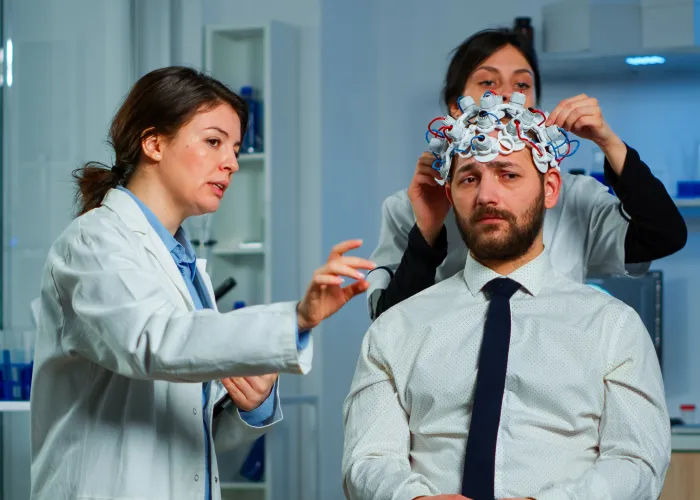
- qEEG Brain Mapping: Identifies irregular neural rhythms often seen in FND.
- Neurological Examination: Rules out structural disease while identifying functional patterns.
- Psychometric Profiling: Assesses cognitive load, stress triggers, and emotional processing.
- Movement & Gait Analysis: Maps motor misfiring and disconnection patterns.
- Whole-Person Evaluation: Integrates physical, psychological, lifestyle, and stress-related contributors.
Treatment
Restoring control by reconnecting the brain’s networks.
- Neuromodulation (rTMS, tDCS, taVNS): Rebalances neural circuits tied to movement, sensation, and emotional regulation.
- Neurofeedback: Helps retrain brain patterns that trigger FND episodes.
- Specialised Physiotherapy: Restores motor control and supports safe, gradual relearning of movement.
- Psychotherapy & Stress Retraining: Addresses triggers, dissociation, emotional overload, and trauma pathways.
- Mind-Body Therapies: Yoga therapy, breathwork, and Ayurveda support nervous system recovery.
- Lifestyle Mapping: Sleep correction, pacing, fatigue management, and nervous-system stabilisation.
Outcomes
Recovery for FND focuses on regaining control, reducing episodes, improving mobility, restoring confidence, and reconnecting body-brain communication. With consistent treatment, most people see significant improvements in function, stability, and daily living.

The Buddhi Clinic Advantage
An integrated neurosciences approach that reconnects mind, brain, and body—uniquely suited for FND.
Our experts decode your FND patterns through clinical evaluation, qEEG insights, physical assessment, and psychological mapping. With a personalised blend of neuromodulation, neuro-rehab, therapy, and mind-body care, we help rebuild function and restore your sense of control.
Answers That Bring Clarity Back to Your Body
Explore expert insights, practical guidance, and clear answers to your most pressing questions about anxiety and its care.
Is FND a real neurological condition?
Yes. FND is a legitimate, medically recognised brain-network disorder. Symptoms are real, not imagined.
Why do my tests come back normal?
Because FND is about network dysfunction (software), not structural damage (hardware). Standard scans don’t show this.
What triggers FND?
Stress, overload, trauma, prolonged anxiety, or even illness/injury. Sometimes the trigger is subtle or unrecognised.
Can FND be treated?
Absolutely. With brain retraining, physical rehab, neuromodulation, and psychological support, recovery is highly achievable.
Do I need medication?
Not always. Treatment focuses on retraining the brain-body system. Medicines help only if associated conditions exist.
Can FND completely go away?
Many people experience significant improvement or complete remission with the right approach and consistent care.
Is FND the same as “psychosomatic illness”?
No. FND is a neurobiological communication issue, not imagined, exaggerated, or voluntary.
